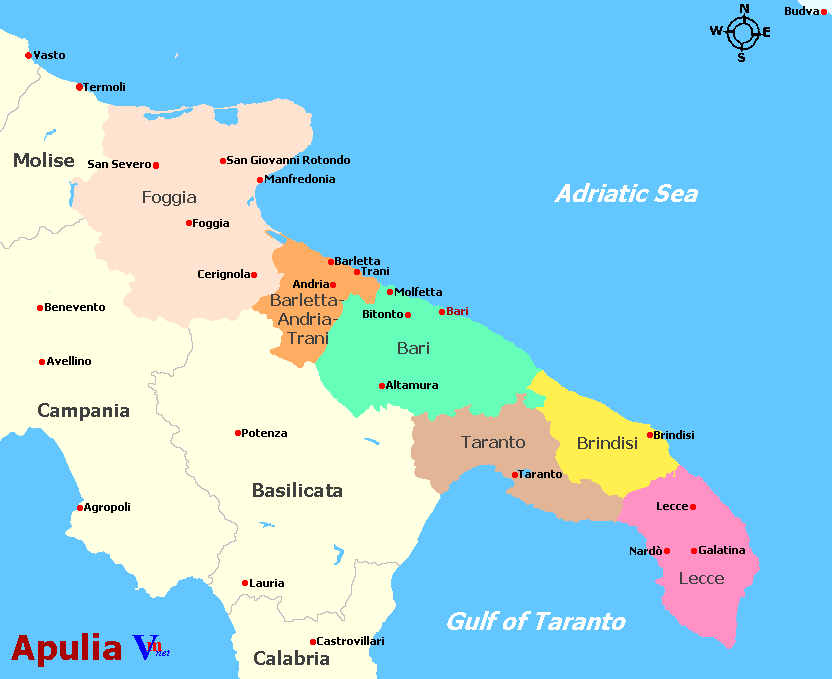
Apulia Wine Region - Italy
Apulia (Puglia) is located in southeastern Italy, forming the "heel" of the Italian peninsula along the
Adriatic and Ionian Seas. The region is one of Italy's largest wine producers by volume and has
historically supplied bulk wine, though quality-focused production has increased significantly in recent
decades.
The climate is warm Mediterranean, with hot, dry summers and mild winters. Coastal influences from
two seas help moderate temperatures, while flat terrain and limestone-rich soils support large vineyard
areas. These conditions are ideal for growing robust red grape varieties.
Classification Structure
Apulia operates under Italy's DOCG, DOC, and IGT system.
DOCG (Denominazione di Origine Controllata e Garantita)
- Primitivo di Manduria Dolce Naturale DOCG
This is the region's only DOCG, focused on sweet wines made from Primitivo.
DOC (Denominazione di Origine Controllata)
Important DOC areas include:
- Primitivo di Manduria DOC
- Salice Salentino DOC
- Castel del Monte DOC
- Brindisi DOC
- Leverano DOC
- Copertino DOC
- Gioia del Colle DOC
- Gravina DOC
- Locorotondo DOC
- Martina Franca DOC
These appellations regulate production and define geographic identity.
IGT (Indicazione Geografica Tipica)
Widely used across the region for flexible production and varietal labeling.
Grape Varieties
Apulia is dominated by red grape production.
Key red grapes:
- Primitivo - Produces rich, high-alcohol wines
- Negroamaro - Structured wines with dark fruit and herbal notes
- Nero di Troia - Increasingly important in quality wines
Key white grapes:
- Bombino Bianco
- Verdeca
- Fiano
- Chardonnay
Wine Styles
Apulia is best known for:
- full-bodied red wines
- ripe fruit flavors and higher alcohol levels
- smooth, approachable styles
Primitivo wines are often compared to Zinfandel due to their genetic relationship. Negroamaro-based
wines are typically more structured and earthy.
White wines are produced in smaller quantities and tend to be fresh and light, especially in northern areas
such as around Castel del Monte.
Climate and Geography
Apulia's viticulture is shaped by:
- flat to gently rolling terrain
- limestone and clay soils
- strong sunlight and long growing seasons
- maritime influence from the Adriatic and Ionian Seas
These conditions favor high yields but also allow for concentration when yields are controlled.
Summary
Apulia is one of Italy's key wine-producing regions, combining:
- large-scale production
- warm Mediterranean climate
- strong identity in Primitivo and Negroamaro
- increasing focus on quality DOC and DOCG wines
The region continues to evolve from bulk wine production toward higher-quality, regionally distinctive
wines.