
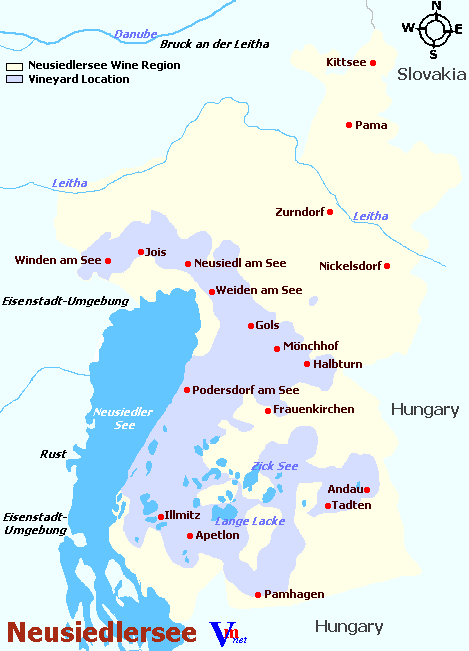
Neusiedlersee is located in eastern Austria in the state of Burgenland, bordering Hungary. The region is named after Lake Neusiedl (Neusiedler See), a large shallow steppe lake that plays a central role in shaping the local climate and viticulture.
Wine production in the area dates back to Roman times, and today Neusiedlersee is one of Austria's most important wine regions. The combination of warm temperatures and high humidity from the lake creates ideal conditions for both red wines and sweet wines.
Neusiedlersee is part of Austria's DAC (Districtus Austriae Controllatus) system.
This designation focuses primarily on red wines made from Zweigelt, the region's flagship grape. Wines labeled Neusiedlersee DAC must meet strict production standards related to grape variety, style, and origin.
Neusiedlersee is known for both red and sweet wine production.
Key red grapes:
Zweigelt
Blaufränkisch
St. Laurent
Key white grapes:
Welschriesling
Chardonnay
Pinot Blanc
Welschriesling is particularly important for sweet wine production.
The region produces a wide range of wine styles:
fruit-driven red wines (Zweigelt-based)
structured reds (Blaufränkisch blends)
botrytized sweet wines (Beerenauslese, Trockenbeerenauslese)
ice wines (Eiswein)
The lake's humidity encourages the development of noble rot (Botrytis cinerea), which is essential for producing high-quality sweet wines.
Neusiedlersee's viticulture is strongly influenced by:
the moderating effect of Lake Neusiedl
warm summers and long growing seasons
high humidity in autumn
flat terrain and surrounding plains
These conditions make the region unique within Austria.
Neusiedlersee is one of Austria's most distinctive wine regions, combining:
a strong red wine identity (Zweigelt)
world-class sweet wine production
a unique lake-influenced climate
modern DAC classification standards
It remains a key part of Austrian wine production and international recognition.