
Wine in Germany
Go to Germany's Main MapGermany is located in Central Europe, bordered by Denmark, Poland, the Czech Republic, Austria, Switzerland, France, Belgium, Luxembourg, and the Netherlands. Viticulture is concentrated mainly in the western and southern parts of the country, particularly along river valleys where slopes, soils, and water influence create favorable growing conditions.
German wine production is organized into 13 official wine regions (Anbaugebiete), including well-known areas such as Mosel, Rheingau, Rheinhessen, Pfalz, Nahe, Franken, Baden, and Ahr. Many vineyards are planted on steep river slopes, especially along the Rhine, Mosel, and Main rivers, which help moderate climate and reflect sunlight.
Germany is internationally associated with Riesling, which is the country's most important grape variety and produces wines ranging from dry to sweet with pronounced acidity and aromatic character. Other key varieties include Muller-Thurgau, Silvaner, Spatburgunder (Pinot Noir), and Grauburgunder (Pinot Gris). Wine styles are diverse, with a strong emphasis on quality classification and site expression.
Map of Germany's Wine Regions
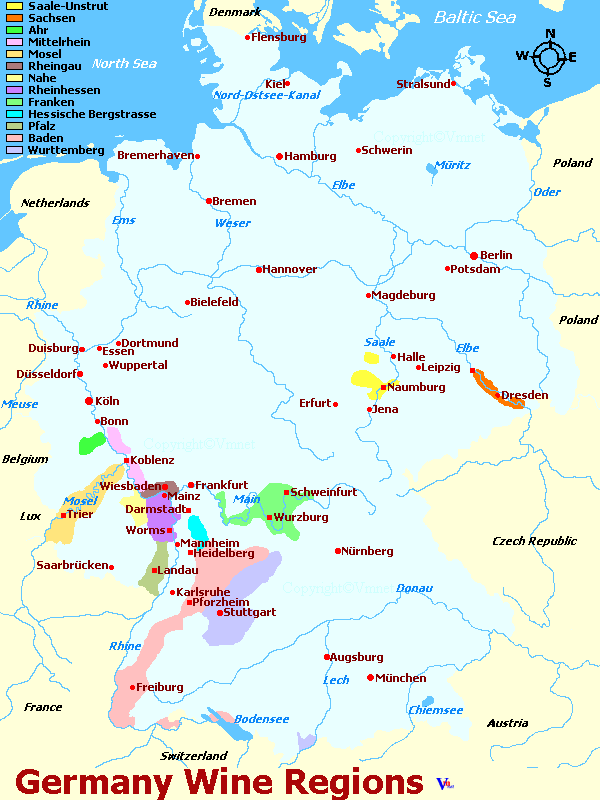
Wine Regions of Germany
AhrBaden
Franken
Hessische Bergstrasse
Mittelrhein
Mosel
Nahe
Pfalz
Rheingau
Rheinhessen
Saale Unstrut
Sachsen
Wurttemberg
Germany
» Map of GermanyMaps
Africa Asia Europe North America South America Oceania World MapQuality classifications for wine used in Germany
Deutscher Tafelwein (simple table wine)
Deutscher Landwein (superior table wine)
Qualitätswein bestimmter Anbaugebiete, abbreviated QbA (quality wine from one of the 13 specified wine-growing regions.
Qualitatswein mit Prädikat, abbreviated QmP (quality wine with special attributes)